


A computer cannot perform all the tasks by itself.So it utilises the entities named functions.
But what is a function?
According to Wikipedia a function means to work or operate in a particular way.
Similarly a function in C also performs a desired task according to the user requirements.
Definition:A function is a self contained block of code that performs a particular task of acting on data and may return a value.
Function prototype
:Datatype function_name(datatype variable-1,datatype variable-2,_ _ _ _)
{ Local declarations;
Executable statements;
Return statement;
}
The part within the curly braces is called the body of the program and the initial line is called the header.The header consists of the function name,the return type of the function and the number and the type of the arguments passed to the function.
Example
Code:
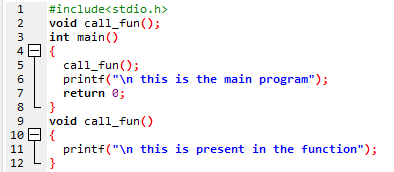
Output:

Explanation:
As the C program executes from top to bottom initially the main() calls the function call_fun().This means that the control passes to function call_fun().The functioning of main is temporarily suspended and the call_fun() starts working.When all the statements in the call_fun() are executed then again the control passes to the main() exactly at the point where the control has been transferred to the call_fun().
Here main() is the calling function and call_fun() is the called function.
Basically there are two types of functions.
1.user defined functions
2.built-in functions
User defined functions: these are created by the user as per the requirement of the program
Built-in functions: these are the part f the standard library and are made available by the compiler as a part of the compiler package.
Passing values between functions:
Example:
#include<stdio.h>
int sum(int x,int y,int z);
int main(){
int a,b,c,result=0;
printf(“\n enter the values of a,b,c:”);
scanf(“%d %d %d”,&a,&b,&c);
result=sum(a,b,c);
printf(“\n THE SUM OF THE NUMBERS IS %d “,result);
return 0;
}int sum(int x,int y,int z){
int p; p=x+y+z;
return (p);
}
Output:enter the value of a,b,c: 2 4 9
THE SUM OF THE NUMBERS IS 15
Explanation:
The values of a,b,c which are read from the user are passed to the function sum() from the main().
In the sum() these values get collected in the variables x,y,z.The variables a,b,c are called the actual parameters and x,y,z are formal parameters.
Any numbers of arguments can be passed to a function.
But the number of parameters and the data type must match otherwise it results in an error.sum() returns a value p which is of data type integer .
So in the function prototype the return type of the function sum() is declared int.
On execution of the return the control directly passes to the calling function and the sum of the three numbers is being returned back to the main().
NOTE:The important point to note here is the scope.The scope of the variables x,y,z is limited only between the braces of the function sum().That means that these cannot be used outside the braces.

